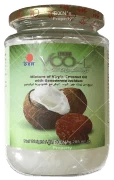
Coconut
The fruit of the coconut palm, whose fresh flesh is pressed into a virgin oil with a coconut scent.
Introduction
The coconut palm (Cocos nucifera) is a tropical palm. Its fruit provides food, drinking water, fibre (coir) and copra, the dried flesh pressed to make oil. Virgin coconut oil is extracted from the fresh, mature flesh by mechanical or natural means, with or without heat, and without chemical refining, so it keeps its coconut scent. It is very rich in saturated fat, especially lauric acid (about half of its fatty acids) and myristic acid.
History
According to a 2011 genetic analysis of more than 1,300 coconuts, the palm was domesticated in two places: island Southeast Asia for the Pacific, and southern India, Sri Lanka and the Maldives for the Indian Ocean. About 2,000 years ago, Austronesian trade routes are thought to have carried Pacific coconuts to Madagascar and the coast of East Africa.
Traditional uses
The flesh is eaten, coconut water is drunk, copra is pressed for oil, the fibre is twisted into rope and the shell is made into charcoal. Virgin oil is used in cooking and baking.
Scientific studies
In 94 healthy adults aged 50 to 75, 50 g a day of virgin coconut oil for 4 weeks gave LDL similar to olive oil and lower than butter; HDL rose more than with butter or olive oil. In 32 healthy young adults, 30 ml a day for 8 weeks raised HDL (+5.7 mg/dl compared with control), with no change in LDL or triglycerides. The authors of the first study say these results do not change the advice to limit saturated fat. Coconut oil is a cooking fat, not a medicine.
Precautions
- Coconut oil is about 82% saturated fat; the American Heart Association advises against using it as an everyday oil because it raises LDL.
- At 30 ml a day, loose stools, stomach ache or nausea were common in the first week: start with small amounts.
- Use it like other fats: in moderation, as part of a varied diet.
Further reading: Harvard Health
Videos
 (English) Mayo ClinicMayo Clinic Minute: Coconut oil — perfect, poison or somewhere in between?Watch on YouTube (opens in a new tab)
Studies and sources
- Randomised trial of coconut oil, olive oil or butter on blood lipids and other cardiovascular risk factors in healthy men and women
94 healthy adults, 50 g a day for 4 weeks: LDL similar to olive oil and lower than butter; HDL higher than with the other two fats.
- Daily Consumption of Virgin Coconut Oil Increases High-Density Lipoprotein Cholesterol Levels in Healthy Volunteers: A Randomized Crossover Trial
32 healthy young adults, 30 ml a day for 8 weeks: HDL +5.7 mg/dl compared with control; LDL and triglycerides unchanged.
- Independent origins of cultivated coconut (Cocos nucifera L.) in the old world tropics
Genetic analysis of more than 1,300 coconuts: two origins of cultivation, one in the Pacific and one in the Indian Ocean.
This information is for discovery only. It does not replace advice from a health professional.